Q7 - Archaeal Phylogeny and the Origin of Eukaryotes
Recent studies of Archaea using metagenomics and improved phylogenetic methods allowed us to:
- Confirm that Eukaryotes originated as a result of a symbiosis between an Archaeal host (“Host”) and a Bacterial endosymbiont (“Symbiont”).
- Search for an Archaeal group which is evolutionarily closest to the “Host.”
The tree below shows the phylogenetic relationship between Bacteria, Eukaryotes and various Archaeal groups based on sequences of ribosomal proteins homologous among all those taxa. Triangles at the tips reflect the fact that each group includes multiple branches.
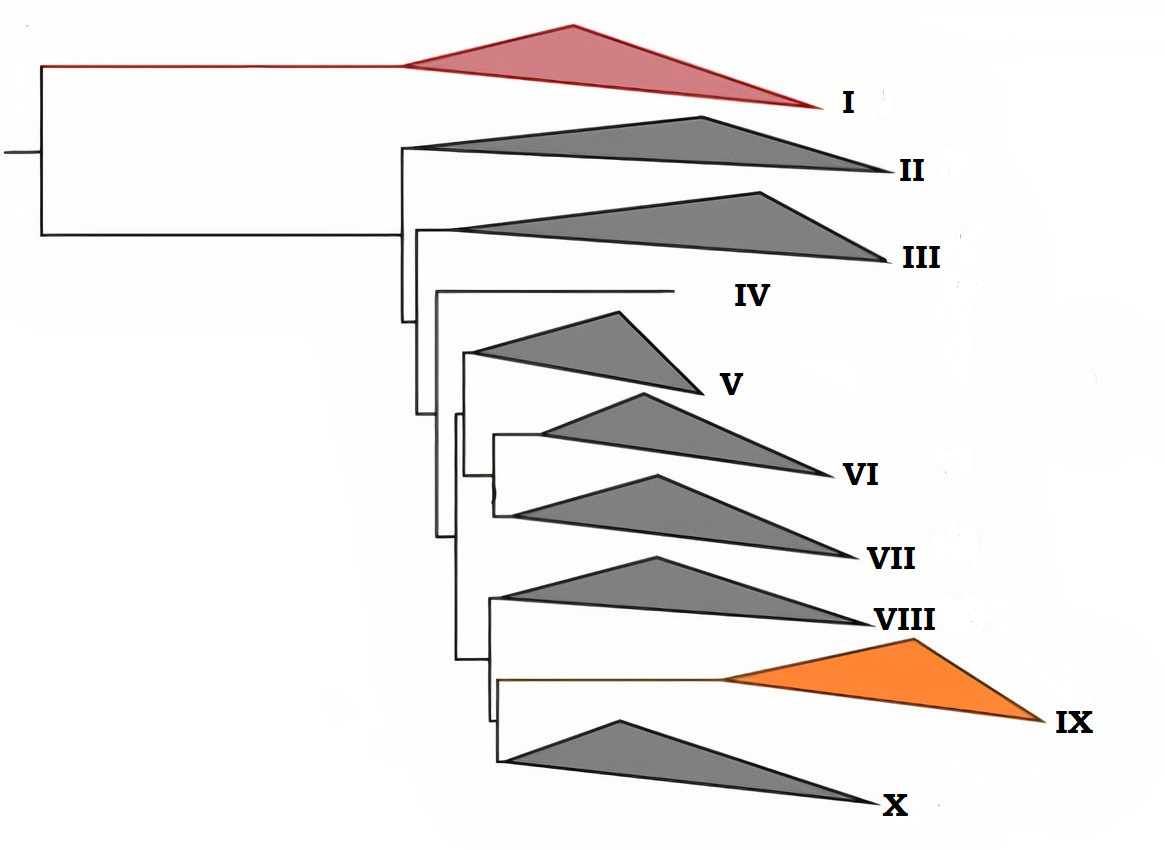 I = Bacteria, II = Nanoarchaeota, III = Ianarchaeota/Micraarchaeota, IV = Altiarchaeota, V = Methanobacteriota, VI = Thermoplasmatota, VII = Halobacteriota, VIII = Thermoproteota, IX = Eukarya, X = Asgardarchaeota.
Imagine a new group of Archaea was discovered. Which of the following features in this group would provide evidence for it being evolutionarily closer to the “Host,” compared to Archaeal groups that lack those features? Indicate such features as “True” and the remaining as “False.”
Question reproduced from IBO 2023, Theoretical Paper 1, licensed under CC BY-NC-SA 4.0 - attributed to the International Biology Olympiad. Open the full exam PDF