Q8 - Gram Staining, Monoderms, Diderms and Firmicute Evolution
Gram-staining has long been used to classify bacteria. Bacteria stain positively by the Gram method if they have a thick-enough layer of exposed peptidoglycan on the surface of their cells.
However, Gram-positive and Gram-negative bacteria are not monophyletic groups and can include species with rather different cell morphologies.
Some microbiologists have proposed to classify bacteria into monoderms, which have only the cytoplasmic membrane, and diderms, which additionally have an outer membrane. However, the evolution of the outer membrane is still a matter of research.
One recent study has investigated the Firmicutes phylum. The result of this study is summarized in Figure 1.
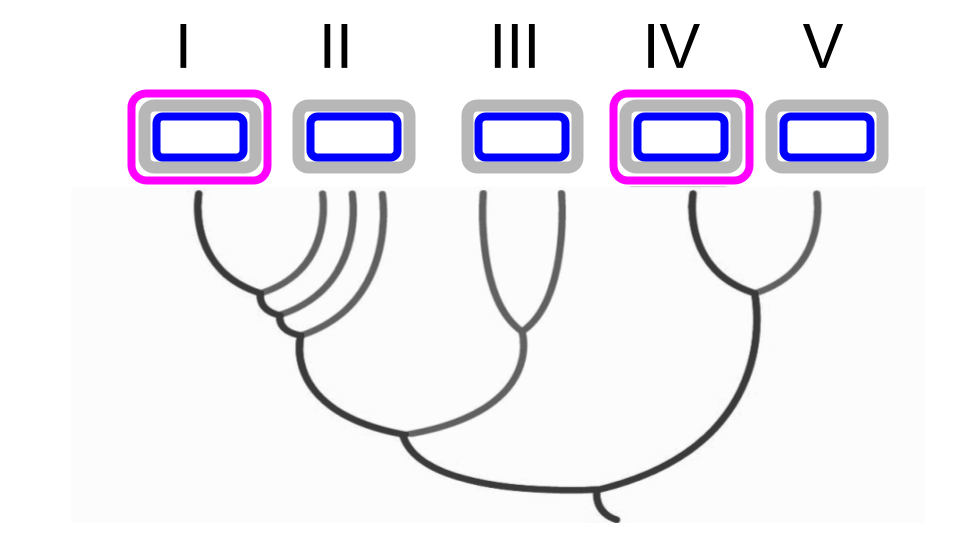 Figure 1. Phylogenetic relationship between various Firmicutes groups. Blue = cytoplasmic membrane, grey = peptidoglycan, purple = outer membrane. I = Negativicutes, II = Clostridiales and Thermoanaerobacterales, III = Bacillales and Lactobacillales, IV = Halanaerobiales, V = Natranaerobiales.
The study also showed that genes associated with the outer membrane are shared between Negativicutes and Halanaerobiales due to vertical transmission, and not due to horizontal gene transfer.
Question reproduced from IBO 2023, Theoretical Paper 1, licensed under CC BY-NC-SA 4.0 - attributed to the International Biology Olympiad. Open the full exam PDF