Q25 - Mitochondrial RNase P Mutations and COXPD54
Mitochondrial RNase P is an endonuclease composed of three subunits (Figure 1B). Mutations in this enzyme are often associated with the development of combined oxidative phosphorylation deficiency syndrome (COXPD54) in humans. The figures below show various information regarding RNase P and its mutations.
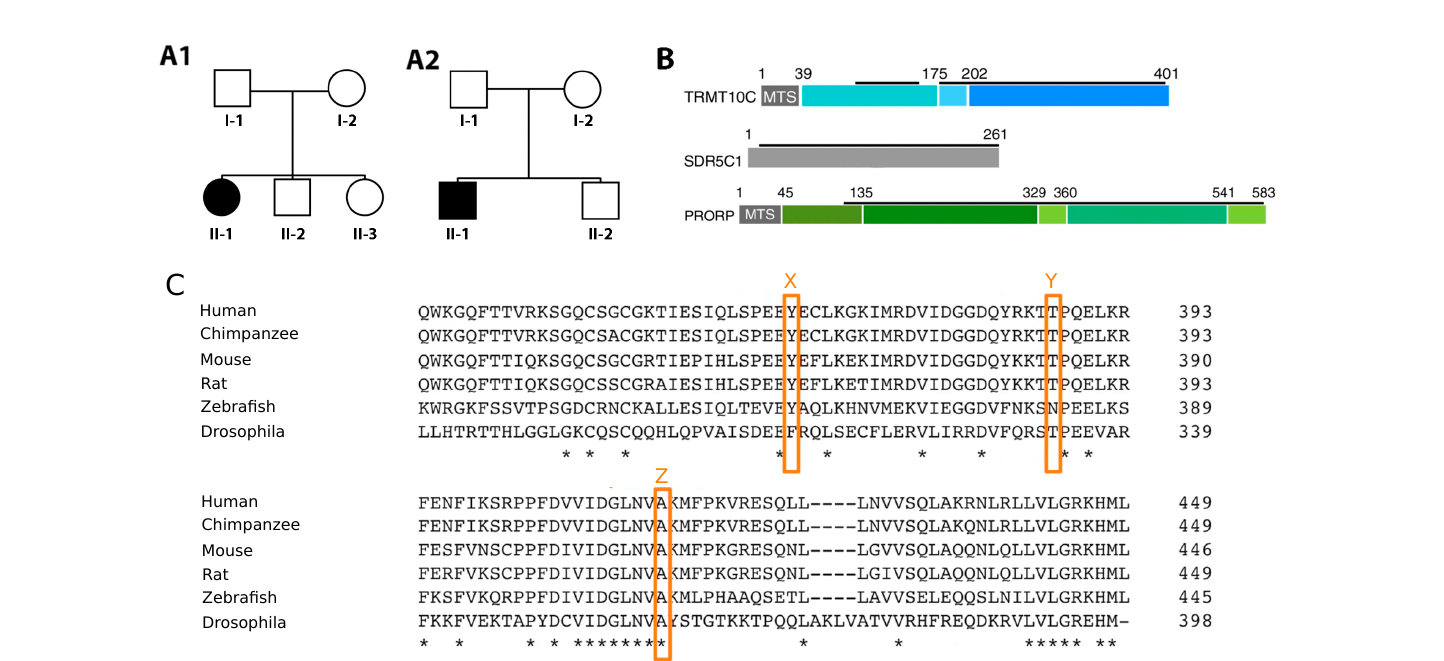 Figure 1. A1 & A2 are pedigrees of two families showing distinct missense mutations resulting in the COXPD54 syndrome in shaded individuals; mutation X for A1 and mutation Y for A2. B RNase P subunits; (MTS - mitochondrial targeting sequence). C Alignment results of the RNase peptide segment across various organisms. Positions affected by the mutations are highlighted in orange boxes. The mutations leading to COXPD54 syndrome are Tyr (Y) → His (H) in position X; Thr (T) → Ala (A) in position Y; Ala (A) → Val (V) in position Z.
On your answer sheet, indicate “T” for true statements and “F” for false ones.
Question reproduced from IBO 2024, Theoretical Exam Part A, licensed under CC BY-NC-SA 4.0 - attributed to the International Biology Olympiad. Open the full exam PDF · Community solutions (unofficial)