Mitochondria & Chloroplasts: Structure & Endosymbiotic Origin
Overview
Scope note: this page covers mitochondrial and chloroplast structure and their shared evolutionary origin. The biochemistry each organelle actually performs is covered elsewhere and not duplicated here: oxidative phosphorylation’s mechanism is in Bioenergetics & Central Metabolism Overview, and photosynthetic light reactions/Calvin cycle biochemistry is fully covered in Plant Physiology’s Light Reactions & Photophosphorylation and Calvin Cycle, Photorespiration & C4/CAM Biochemistry pages.
Key Concepts
Why these two organelles are structural exceptions
Every other organelle covered in Endomembrane System & Protein Trafficking is either single-membrane or arose via vesicular budding from the ER/Golgi pathway. Mitochondria and chloroplasts break this pattern entirely: both are bound by two membranes (not one), both contain their own circular DNA genome distinct from the nuclear genome, both retain their own 70S ribosomes (matching bacterial, not cytoplasmic 80S, ribosomes, see Cell Theory, Prokaryotes & Eukaryotes), and both replicate by binary fission, independently of the cell cycle that governs nuclear division. None of this fits the ER/Golgi-derived vesicular model: because these two organelles did not arise that way.
The endosymbiotic theory
The endosymbiotic theory (most associated with Lynn Margulis) proposes that mitochondria and chloroplasts originated as free-living prokaryotes engulfed by a host cell in an ancient endocytic event, which, rather than being digested, survived as a stable intracellular symbiont and was retained across subsequent generations, eventually losing its independence and becoming an obligate organelle.
Evidence supporting this theory, and why each piece of evidence specifically supports an endosymbiotic rather than an internally-evolved origin:
- Double membrane: the inner membrane is interpreted as the original bacterial plasma membrane; the outer membrane as derived from the host’s engulfing endocytic membrane: exactly the two-membrane signature expected from an engulfment event, and not easily explained by internal budding from a single-membrane precursor.
- Own circular genome: bacterial-style circular DNA, distinct from and much smaller than the nuclear genome, consistent with a once-independent bacterial chromosome, most of whose genes have since been lost or transferred to the nuclear genome over evolutionary time (endosymbiotic gene transfer).
- Own 70S ribosomes: matching bacterial ribosome size, not the 80S cytoplasmic ribosome of the host eukaryotic lineage: a strong molecular fingerprint of bacterial ancestry, since ribosome size is a deeply conserved trait not easily convergent.
- Binary fission, independent of the cell cycle: mitochondria and chloroplasts divide by a bacterial-style fission mechanism (involving an FtsZ-related protein, homologous to the bacterial division protein) on their own schedule, rather than being newly synthesised each cell cycle the way other organelles are, behaviour expected of a formerly independent organism, not an internally derived compartment.
- Sequence homology: mitochondrial and chloroplast genes/rRNA sequences show closer phylogenetic relationship to specific bacterial lineages (α-proteobacteria for mitochondria, cyanobacteria for chloroplasts) than to the eukaryotic nuclear genome, direct molecular phylogenetic evidence, and the single strongest line of evidence overall.

Mitochondria: structure
The mitochondrial outer membrane is smooth and relatively permeable (contains porins allowing free passage of small molecules); the inner membrane is highly folded into cristae, dramatically increasing surface area for the electron transport chain complexes and ATP synthase embedded within it (see Bioenergetics & Central Metabolism Overview for the chemistry these structures perform). The intermembrane space (between the two membranes) is where the proton gradient driving ATP synthase is built; the matrix (enclosed by the inner membrane) contains the mitochondrial genome, ribosomes, and the enzymes of the TCA cycle.

Chloroplasts: structure
Chloroplasts share the double-membrane, own-genome, own-ribosome pattern, but add a third internal membrane system: thylakoids, flattened membrane sacs (often stacked into grana) suspended in the stroma (the chloroplast’s matrix-equivalent compartment). The thylakoid membrane houses the light-reaction machinery (photosystems, electron transport chain, ATP synthase): directly analogous in mechanism to the mitochondrial inner membrane’s ETC/ATP synthase, but running in the reverse net direction (building reducing power and ATP from light energy, rather than from stored chemical bond energy). The stroma houses the Calvin cycle enzymes. Both the thylakoid-vs-cristae membrane elaboration and the parallel “membrane houses electron transport chain, matrix/stroma houses the cycle” organisation are a direct structural echo of each other, consistent with both organelles having converged on the same chemiosmotic strategy independently from their respective free-living bacterial ancestors.
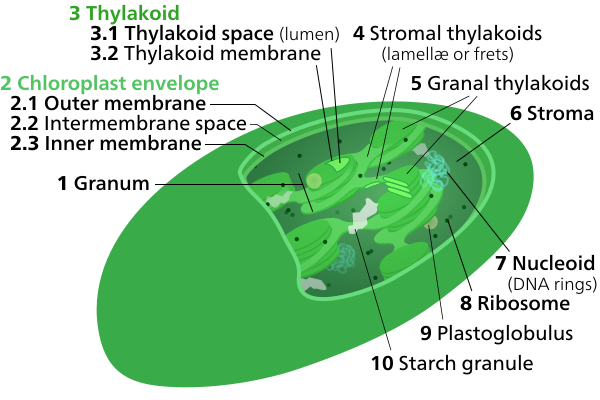 Source: en.wikipedia.org (Thylakoid)
Semi-autonomy, not full independence
Despite retaining their own genome, neither organelle is genetically self-sufficient: the large majority of proteins actually functioning inside mitochondria and chloroplasts today are encoded by the nuclear genome, synthesised on cytoplasmic 80S ribosomes, and imported post-translationally via dedicated protein-import machinery (translocase complexes in the outer and inner membranes), a consequence of endosymbiotic gene transfer, the gradual evolutionary migration of genes from the original bacterial genome into the host nuclear genome over the (roughly) 1.5–2 billion years since the original endosymbiotic events. This is why both organelles are described as semi-autonomous: genetically active but no longer independent, dependent on nuclear-encoded, cytoplasmically-synthesised, imported proteins to build most of their own machinery.
Comparative Structures
| Feature | Mitochondria | Chloroplasts |
|---|---|---|
| Membranes | 2 (outer, inner) | 2 (outer, inner) + internal thylakoid system |
| Inner membrane folding | Cristae | Thylakoids (often stacked as grana) |
| Matrix-equivalent compartment | Matrix (TCA cycle) | Stroma (Calvin cycle) |
| Genome | Circular, bacterial-style | Circular, bacterial-style |
| Ribosome | 70S | 70S |
| Proposed bacterial ancestor | α-proteobacteria | Cyanobacteria |
| Net energy conversion | Chemical (organic fuel) → ATP | Light → chemical (ATP, NADPH, then sugar) |
Common Exam Questions
- “List the evidence for endosymbiotic origin”: a complete answer names multiple independent lines of evidence (double membrane, own genome, own ribosomes, independent binary fission, sequence phylogeny), not just one; partial-credit answers that name only “they have their own DNA” miss most of the available evidence.
- “Why do mitochondria/chloroplasts have a double membrane specifically?”, the inner membrane is the original bacterial plasma membrane; the outer is derived from the host’s engulfing membrane during the original endocytic event.
- “Are mitochondria/chloroplasts fully autonomous?”, no; the correct nuanced answer (semi-autonomous) requires knowing that most organellar proteins are actually nuclear-encoded and imported, despite the organelle retaining its own genome and translation machinery.
Visual Reference
Interactive
- An endosymbiosis evidence checklist: click each line of evidence (double membrane, own genome, 70S ribosomes, binary fission, sequence homology) to reveal why it specifically supports endosymbiotic rather than internal origin, reinforcing that this is a multi-line argument, not a single fact.
Static
(Static images are placed inline in Key Concepts above, next to the concept each one illustrates, rather than collected here.)
Practice Challenge
Competition-sourced practice questions for this topic, graded by difficulty. Click the Solution tab to reveal each answer.
According to the “Endosymbiont” hypothesis, the first aerobic eukaryote must have evolved around 1.5 billion years ago when Earth’s atmosphere started accumulating O2 in significant quantities. Choose the correct path that depicts this hypothesis
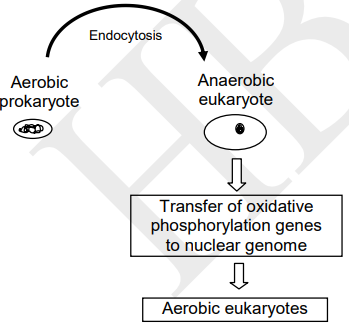
A. B. C. D.
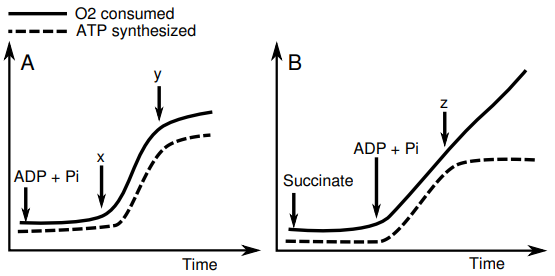
When isolated mitochondria are suspended in a buffer containing ADP, Pi, and an oxidizable substrate, three easily measured processes occur: the substrate is oxidized; O2 is consumed; and ATP is synthesized. Cyanide (CN-) is an inhibitor of the passage of electrons to O2. Oligomycin inhibits ATP synthase by interacting with subunit F0. 2,4-dinitrophenol (DNP) can diffuse readily across mitochondrial membranes and release a proton into the matrix, thus dissipating the proton gradient.
Indicate if each of the following statements is True or False.
A. x is the oxidizable substrate.
B. y is either oligomycin or CN -.
C. z is DNP.
D. If z is a mixture of oligomycin and DNP, the ATP synthesis will not level off.
The gene cox2 encodes one of the subunits of cytochrome c oxidase (Complex IV). Its distribution and expression in mitochondria and nuclei of four extant plant species is given below.
| Species | Gene | mRNA | ||
|---|---|---|---|---|
| Mitochondria | Nucleus | Mitochondria | Nucleus | |
| 1 | + | + | + | + |
| 2 | + | - | + | - |
| 3 | - | + | - | + |
| 4 | + | + | + | - |
Mark the most appropriate phylogenetic classification that is also compatible with the endosymbiotic theory.
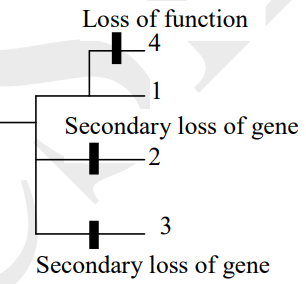
A. B.
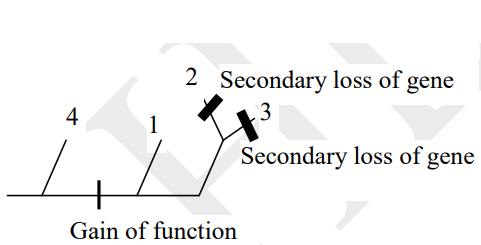
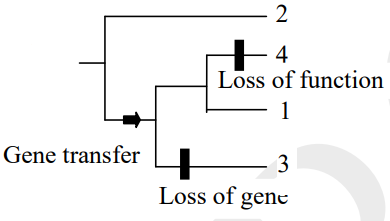
C. D.
The table shows that human mitochondrial DNA (mtDNA) encodes some, but not all, of the protein subunits in the respiratory complexes.
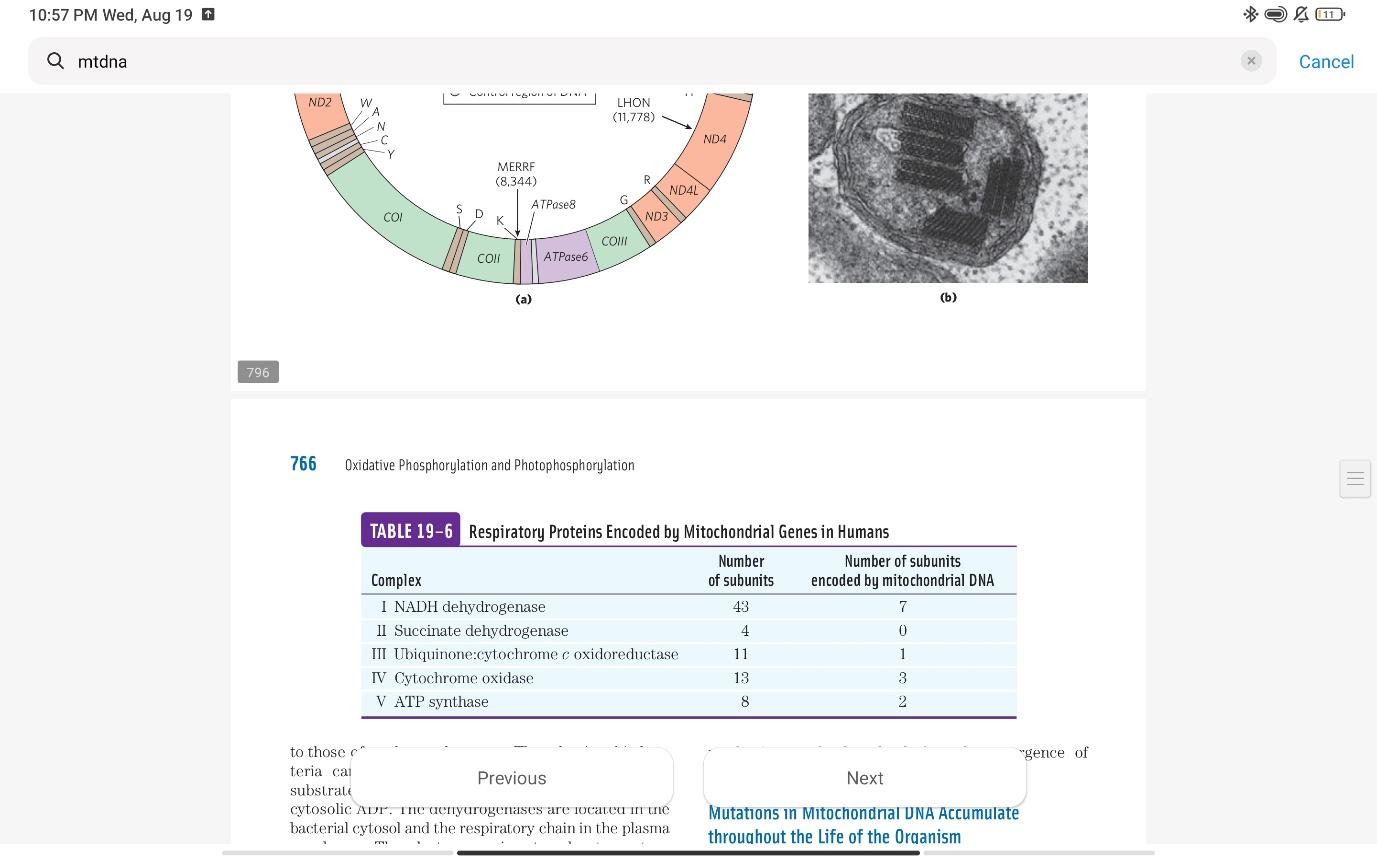
An aspiring biologist thinks there might be some error with some of the data in the table and proposes the following hypothesis:
Hypothesis: All respiratory protein complexes contain at least one subunit synthesized using mitochondrial ribosomes.
To test this hypothesis, isolated human cells are subjected to a pulse-chase experiment using a radioactive amino acid. During the pulse, cells are divided into two groups:
Group 1: Cytoplasmic protein synthesis is inhibited, while mitochondrial protein synthesis can continue. Group 2: Mitochondrial protein synthesis is inhibited, while cytoplasmic protein synthesis can continue.
After the pulse, cells are returned to normal conditions during the chase. The respiratory complexes are then isolated and tested for radioactive labelling of their protein subunits.
Using the information in the table, determine whether each statement is true or false:
A. Complex II should contain no radioactively labelled subunits in Group 1 because none of its four subunits are encoded by mtDNA.
B. The fluorescence intensity of Complexes III, IV and V in Group 1 should be proportional to the total number of subunits in each complex, because each complex contains subunits encoded by mtDNA.
C. The results for Complex II would contradict the student’s hypothesis because Complex II can be assembled entirely from subunits synthesized from nuclear genes.
D. If Complex IV shows radioactive labelling in both groups, this would support the conclusion that its subunits are encoded by both nuclear DNA and mtDNA.
Practice Problems
1. A researcher sequences the genome of a newly discovered intracellular structure in a protist and finds it to be circular, bacterial-style DNA with strong sequence similarity to a specific cyanobacterial lineage. What is the most likely identity and evolutionary origin of this structure?
Show answer
Most likely a chloroplast (or chloroplast-derived plastid), of endosymbiotic origin from a cyanobacterial ancestor. Circular bacterial-style DNA with cyanobacterial sequence similarity is the direct molecular phylogenetic signature expected of a chloroplast, distinguishing it from a mitochondrion (which would instead show α-proteobacterial similarity) or a non-endosymbiotic organelle (which would show no bacterial sequence relationship at all).
2. Explain why the statement “mitochondria are fully independent, self-sufficient organisms living inside the cell” is inaccurate, using the concept of endosymbiotic gene transfer.
3. Both mitochondrial cristae and chloroplast thylakoids dramatically increase internal membrane surface area relative to a smooth, unfolded membrane. Explain why this structural strategy is functionally important for both organelles, referencing what is embedded in each membrane.