Q27 - Beta-Lactamase Mutational Trajectories and Epistasis
Five mutations in beta-lactamase can significantly affect its ability to degrade third-generation antibiotics like cefotaxime: Mut1, Mut2, Mut3, Mut4, Mut5. Since they can appear in any order there are 5! (=120) potential trajectories of resistance development. However, only 18 of them are evolutionarily accessible. The term “evolutionarily accessible” refers to the ability of a particular mutational pathway to produce an advantageous phenotype during the evolution. Implications from this simple model could be used to understand the evolution of more complex traits.
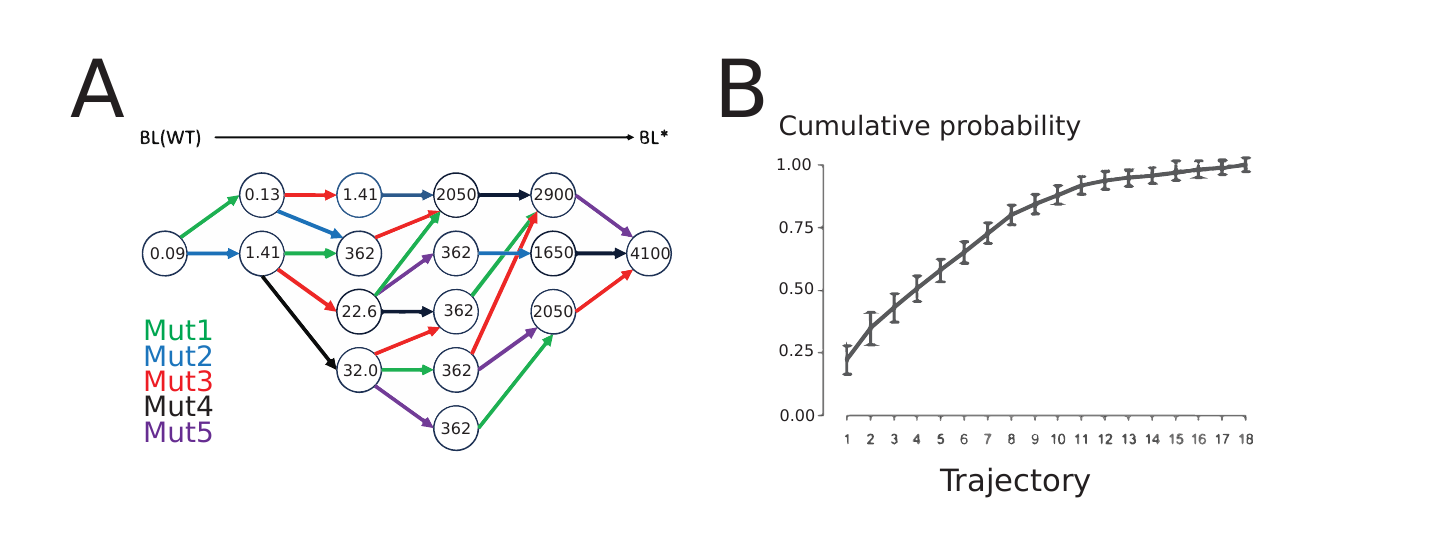 Figure 1. A Graph showing the ten most probable trajectories leading from wild-type beta-lactamase (BL(WT)) to an improved version (BL), the efficiency of each phenotype indicated on the node. Colored arrows represent the five potential mutations. B The cumulative probability of each of the 18 possible trajectories.*
On your answer sheet, indicate “T” for true statements and “F” for false ones.
Question reproduced from IBO 2024, Theoretical Exam Part A, licensed under CC BY-NC-SA 4.0 - attributed to the International Biology Olympiad. Open the full exam PDF · Community solutions (unofficial)