Q29 - Endogenous Retroviruses and Retrotransposons
Retroviruses are RNA viruses that have RNA to DNA reverse transcription steps in their life cycle. Some can become endogenous retroviruses (ERVs), where they integrate into the host genome and become heritable. Retrotransposons are genetic elements that can spread over the genome using RNA intermediate for translocation. There is some evolutionary relationship between retrotransposons and ERVs. ERVs and retrotransposons are valuable parts of our genome that provide extra genetic material for evolution.
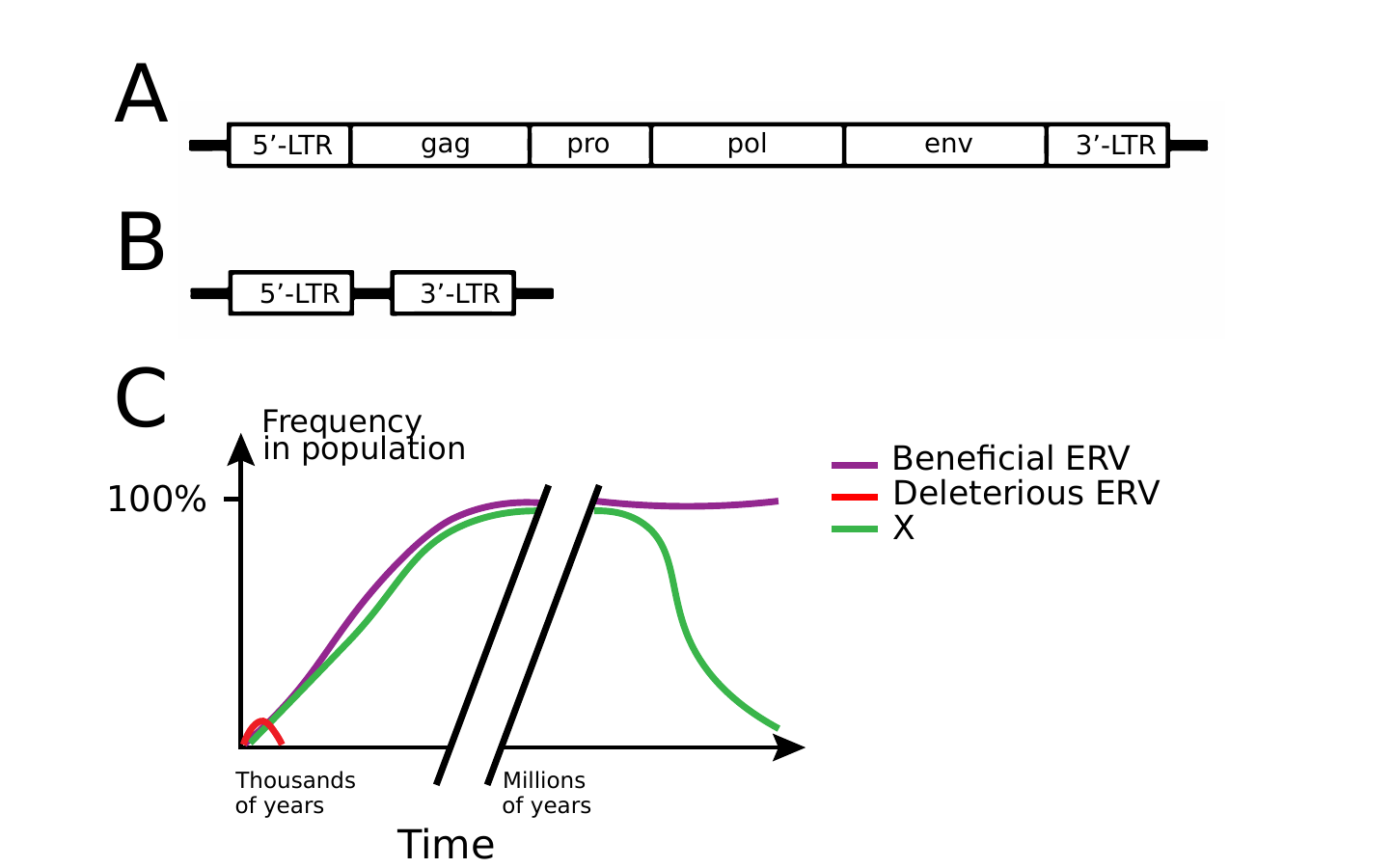 Figure 1. A Common structure of ERV, LTR - identical long terminal repeats, gag - virion structural protein, pro - viral protease necessary for virion maturation, pol - reverse transcriptase, env - glycoprotein envelope protein. B Solo-LTR (empty ERV derivative). C Changes in frequencies of beneficial and deleterious ERVs after many generations.
On your answer sheet, indicate “T” for true statements and “F” for false ones.
Question reproduced from IBO 2024, Theoretical Exam Part A, licensed under CC BY-NC-SA 4.0 - attributed to the International Biology Olympiad. Open the full exam PDF · Community solutions (unofficial)