Q30 - Gibberellin Transport and Root Endodermis Suberization
Gibberellin, an essential phytohormone responsible for cell wall suberization, undergoes complex transport within plants involving a variety of transporters. Below are figures depicting results from studies on different membrane transporters of gibberellin.
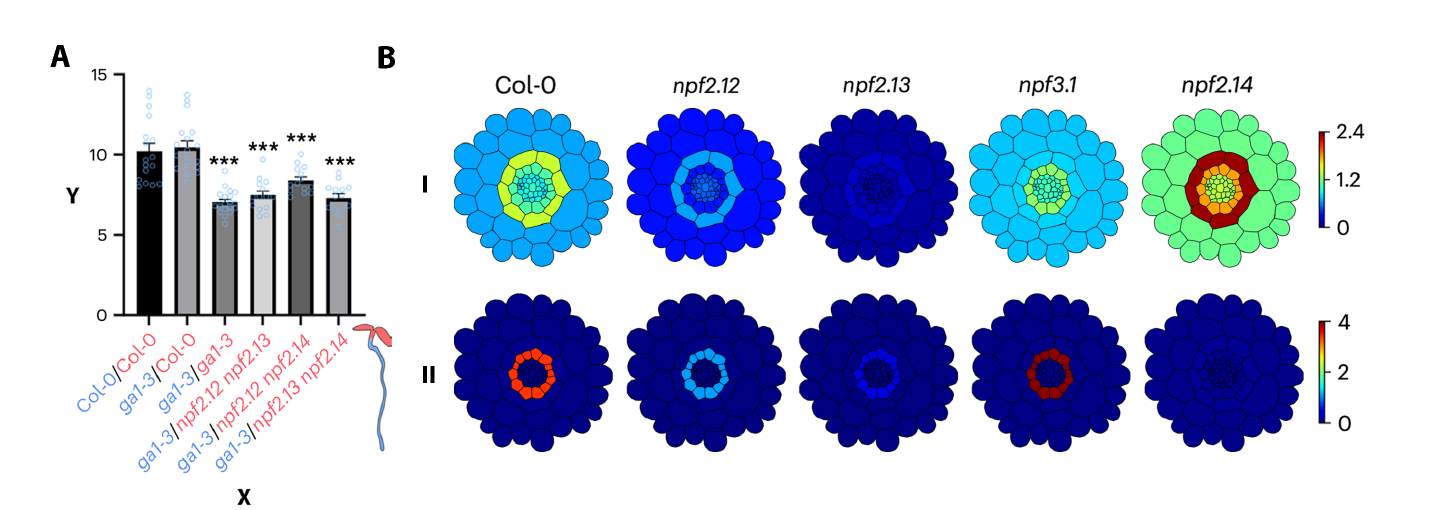 Figure 1. A Fluorescence intensity (Y) of root endodermal cells in grafted plants (X, root/shoot). Samples were treated with a fluorescent marker for suberin (Nile red); asterisks indicate a significant difference from the wild type. Col-0 - wild type, ga1-3 - mutant lacking gibberellin synthesis, npf__ - mutants lacking expression of a specific type of transporter(s). B Cytoplasmic (I) and vacuolar (II) concentrations of gibberellin (arbitrary units) in the root.
On your answer sheet, indicate “T” for true statements and “F” for false ones.
Question reproduced from IBO 2024, Theoretical Exam Part A, licensed under CC BY-NC-SA 4.0 - attributed to the International Biology Olympiad. Open the full exam PDF · Community solutions (unofficial)