Q32 - Poaceae Stomata Synchronization Mechanism
Poaceae (grass family) stomata have a “dumbbell” shape and a stronger connection between guard and subsidiary cells. Due to this adaptation, they respond to stimuli faster than non-Poaceae stomata. Specifically, alternating hyperpolarization (H) and depolarization (D) of cell membranes allow well-synced osmotic flow by activating the ion channels, as shown in Figure 1. Non-Poaceae stomata do not sync this closely.
Due to the advanced geometry of Poaceae stomata, subsidiary cells actually lose turgor when guard cells gain it, and vice versa. That leads to the widest possible open pore, as the subsidiary cell “bends inward” to accommodate the growing guard cell.
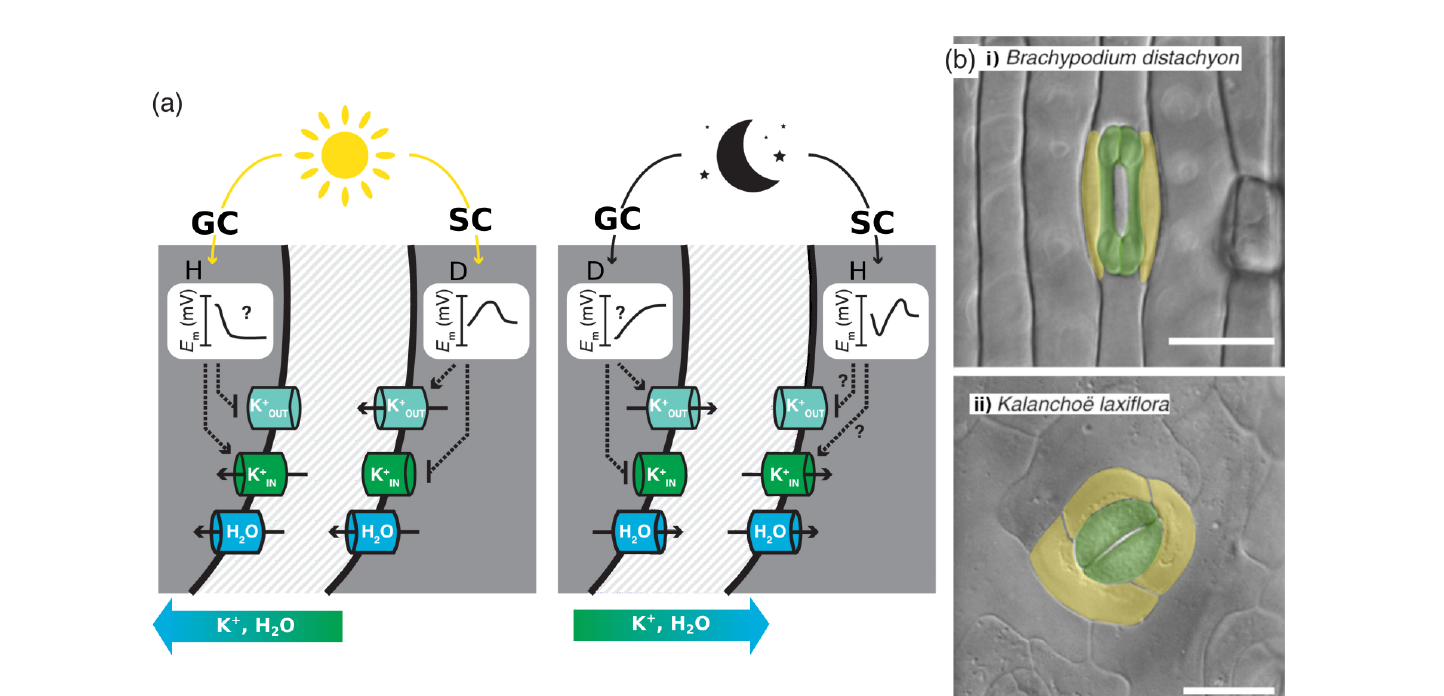 Figure 1. A) Schematic representation of Poaceae stomata synchronization mechanism. Guard cells are GC, and subsidiary cells are SC on the diagram. Question marks imply the effect has only partially been verified; blue H2O cylinders are aquaporins. B) Highlighted micrograph of a Poaceae (i) and non-Poaceae (ii) stomata.
On your answer sheet, indicate “T” for true statements and “F” for false ones.
Question reproduced from IBO 2024, Theoretical Exam Part A, licensed under CC BY-NC-SA 4.0 - attributed to the International Biology Olympiad. Open the full exam PDF · Community solutions (unofficial)