Q50 - Countercurrent System and Nephron Function
The countercurrent system is a common biological pattern, classified into countercurrent multipliers and exchangers. In vertebrates, these systems often involve a specialized network of arteries and veins lying close together, known as the rete mirabile. In humans, an example of this system is found in the kidneys, where the nephron and vasa recta together form a countercurrent multiplier. This arrangement allows for efficient exchange and concentration of solutes and water, which are crucial in urine concentration and maintaining the body’s fluid balance.
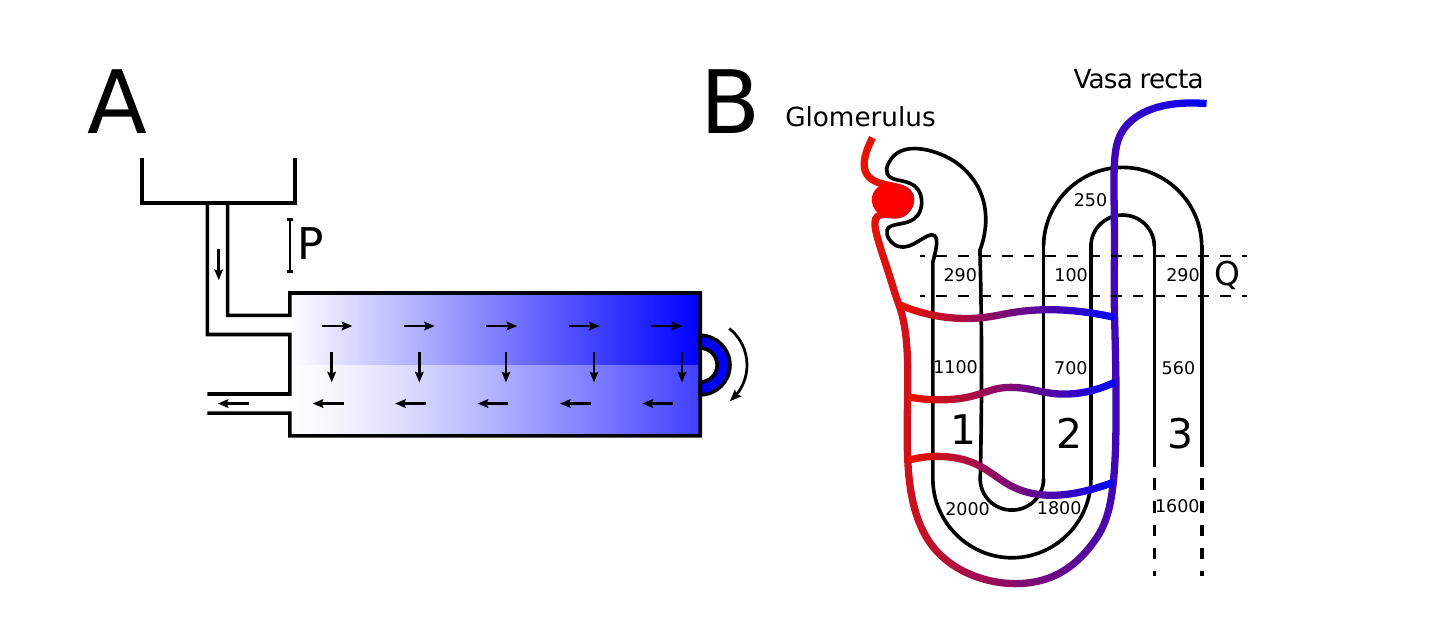 Figure 1. A Countercurrent osmotic multiplier: solute passes through a reservoir separated by a semipermeable membrane; black arrows show water movement driven by pressure P. B Nephron diagram: 1 - descending limb, 2 - ascending limb, 3 - collecting duct. Numbers indicate osmolarity (mOsmol/kg).
On your answer sheet, indicate “T” for true statements and “F” for false ones.
Question reproduced from IBO 2024, Theoretical Exam Part A, licensed under CC BY-NC-SA 4.0 - attributed to the International Biology Olympiad. Open the full exam PDF · Community solutions (unofficial)