Q11 - Proteasome vs. Lysosome Degradation and Protein Half-Life
Proteasomes, cytoplasmic multiprotein complexes, and lysosomes are major proteolysis (protein degradation) sites in eukaryotic cells.
In Figure 1-a, researchers studied the abundance of proteins A, B, and C over time in cultured human cells using cycloheximide, an inhibitor of translation elongation in eukaryotic 80S ribosomes. Note that cycloheximide does not affect the abundance of protein A, whose half-life is shorter than that of protein B.
In Figure 1-b, they observed how MG132, a proteasome inhibitor, and chloroquine, a lysosome inhibitor, affect the abundance of proteins B and C over time under cycloheximide treatment.
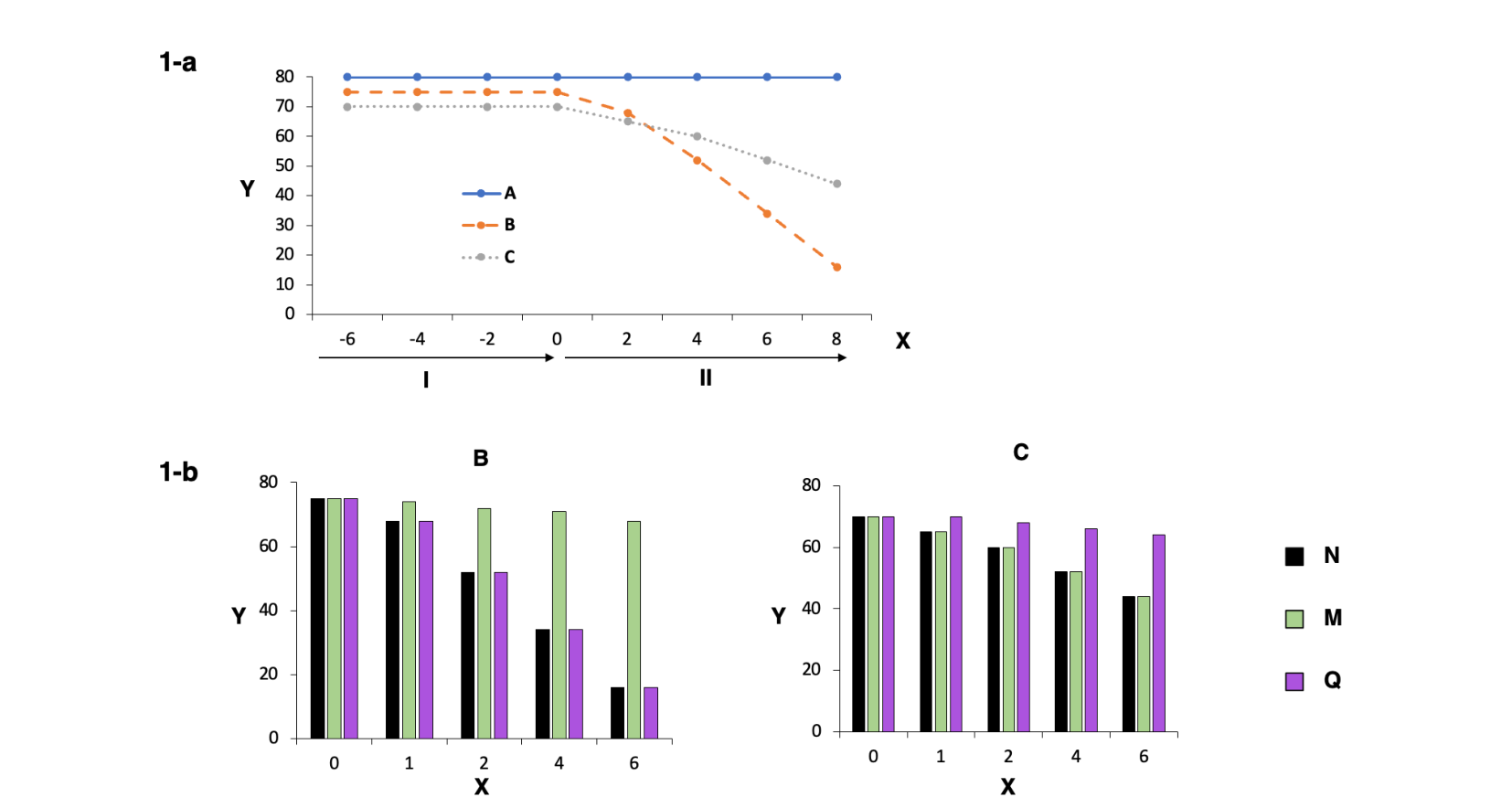 Figure 1. 1-a Y: Protein abundance, X: Time (hours), I: Before adding cycloheximide, II: After adding cycloheximide, A: protein A, B: protein B, C: protein C. 1-b Y: Protein abundance, X: Time after adding cycloheximide (hours), B: protein B, C: protein C, N: control, M: MG132, Q: Chloroquine.
On your answer sheet, indicate “T” for true statements and “F” for false ones.
Question reproduced from IBO 2024, Theoretical Exam Part B, licensed under CC BY-NC-SA 4.0 - attributed to the International Biology Olympiad. Open the full exam PDF