Q12 - FRET-Based Protease Activity and Inhibitor Mechanism
Förster Resonance Energy Transfer (FRET) is a technique used to study the interaction between two chromophores, donor and acceptor. The donor (D) can be excited by light of a specific wavelength, raising the energy of an electron in the molecule. When far away from the acceptor (A), it will emit light via fluorescence. However, when it is within 10 nm of an acceptor molecule, it can “transfer” its energy to the acceptor, which then releases the absorbed energy as a different wavelength of light.
For an efficient FRET, the emission spectra of the donor must overlap with the excitation spectra of the acceptor. A table lists some chromophores’ excitation and emission spectra, including CFP and YFP. Researchers used FRET to find the optimal protease. Here, CFP and YFP fluorescent proteins are linked (CFP-YFP) with the protease-target peptide sequence. Researchers also observed the effect of two inhibitors on Protease P3 by using FRET. Note that one inhibitor is competitive, while the other is non-competitive.
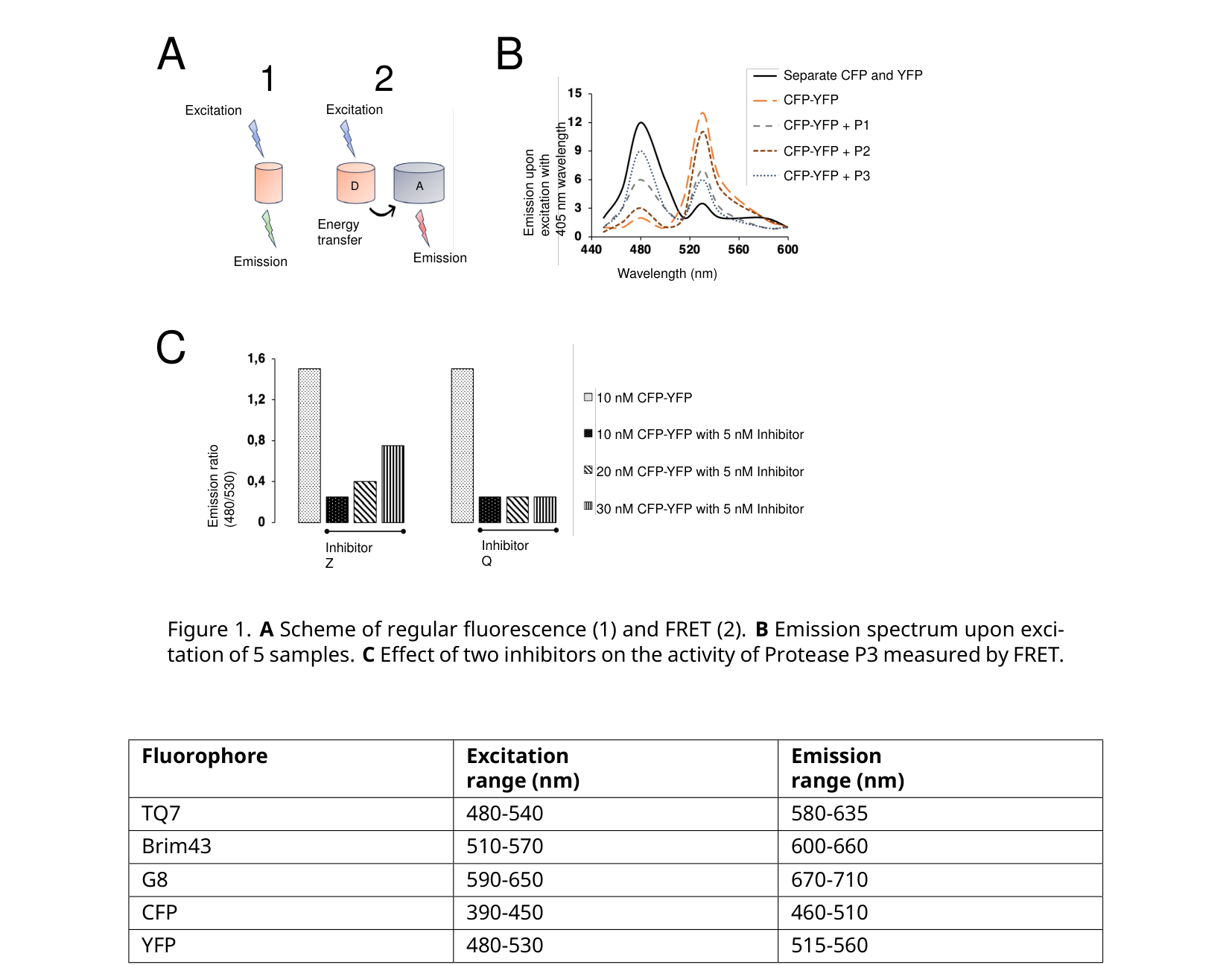 Figure 1. A Scheme of regular fluorescence (1) and FRET (2). B Emission spectrum upon excitation of 5 samples. C Effect of two inhibitors on the activity of Protease P3 measured by FRET. Table 1. Excitation and emission spectra of some fluorophores.
On your answer sheet, indicate “T” for true statements and “F” for false ones.
Question reproduced from IBO 2024, Theoretical Exam Part B, licensed under CC BY-NC-SA 4.0 - attributed to the International Biology Olympiad. Open the full exam PDF