Q7 - DNA Fiber Assay and Replication Fork Progression
DNA fiber assay is used to study various aspects of DNA synthesis, such as replication speed, replication origin firing, and replication termination. It utilizes modified nucleotides to visualize the progression of DNA replication directly. In this assay, cellular DNA is sequentially labeled with chloro-deoxyuridine (CldU) followed by iodo-deoxyuridine (IdU), each for an equal period. Upon replication, cells incorporate these modified nucleotides into newly synthesized DNA. Next, cells are lysed and individual DNA fibers are stretched on a microscopic slide, followed by CldU (red) and IdU (blue) antibody staining. Finally, DNA fibers are visualized by fluorescent microscopy.
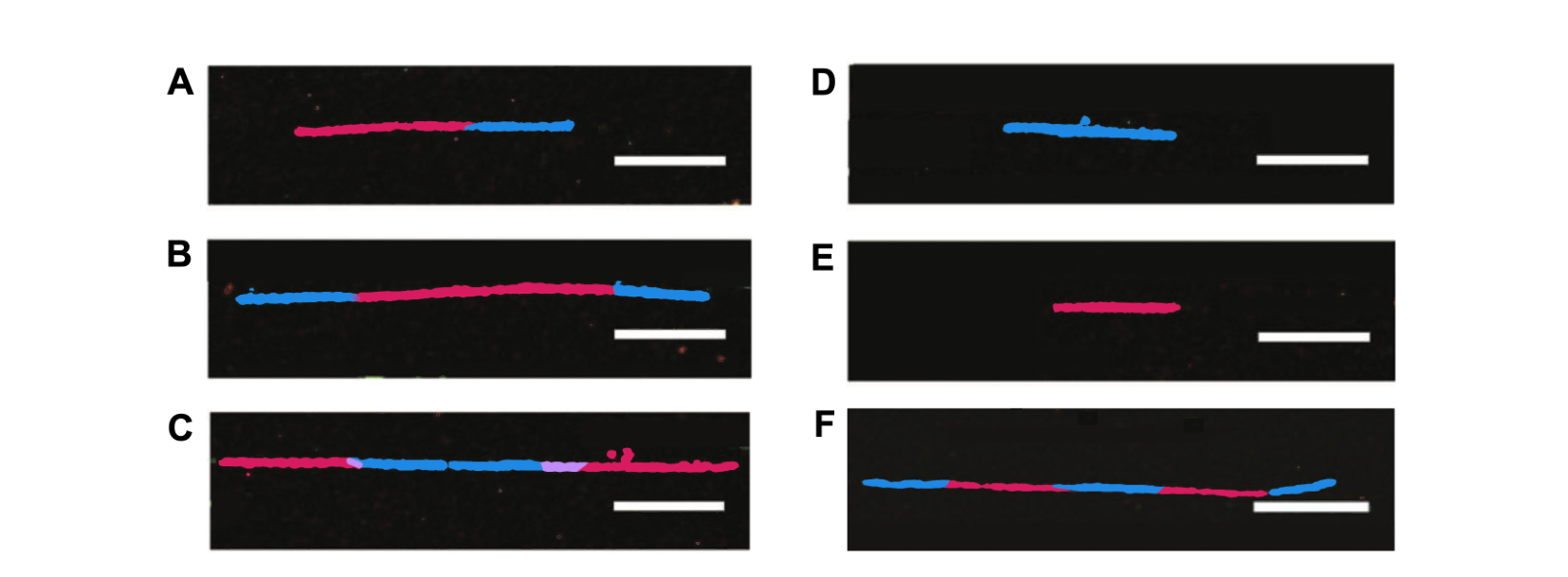 Figure 1. Panels A-F represent replicated DNA segments. Each panel shows a single uninterrupted DNA molecule labeled with CldU (red) followed by IdU (blue). The white bar at the bottom right of each panel is a scale bar of 10 μm. The DNA in all panels is from the same organism.
On your answer sheet, indicate “T” for true statements and “F” for false ones.
Question reproduced from IBO 2024, Theoretical Exam Part B, licensed under CC BY-NC-SA 4.0 - attributed to the International Biology Olympiad. Open the full exam PDF