Q70 - Land Plant Phylogeny and Shared Derived Characters
Over the last 470 million years, plant evolution has seen major evolutionary transitions, such as the move from water to land. The following figure shows the phylogenetic tree of the major plant groups.
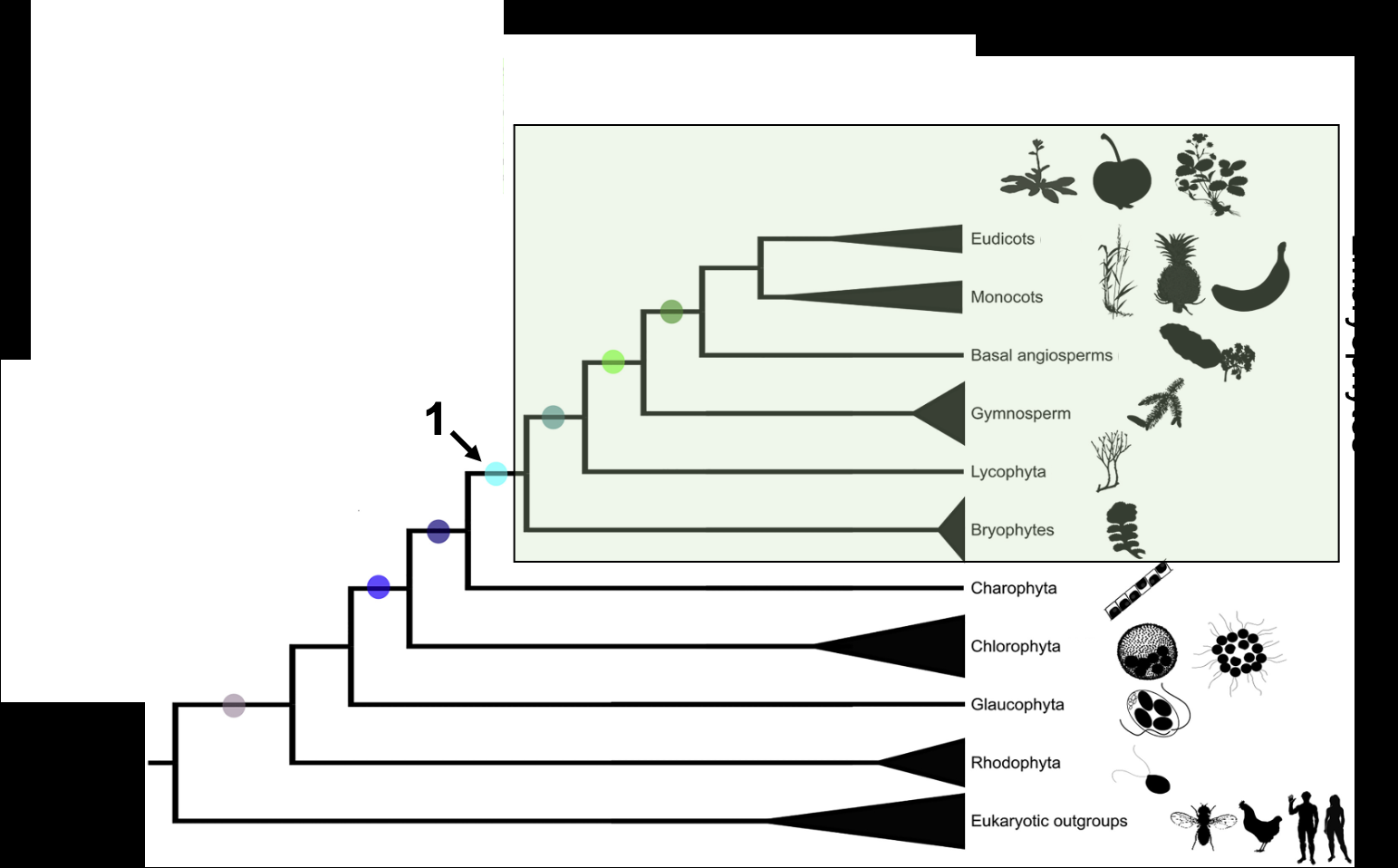 Figure 1. The phylogenetic tree of plants and algae. Each colored circle indicates an unspecified shared derived characteristic of a taxon. Other eukaryotic outgroups are included as a cluster for reference.
Use the information and figure to determine whether the following statements are true or false.
A. The shared derived characters of land plants (cyan colored circle labeled 1 on the figure) include multicellular embryos as adaptations for terrestrial life.
B. The cladogram suggests that Charophyta is the direct common ancestor of all terrestrial plants.
C. Multicellularity was lost in some embryophyte taxa.
D. Rhodophyta are most closely related to Glaucophyta, based on their proximity in the phylogenetic tree.
Question reproduced from IBO 2022, Theoretical Paper 2, licensed under CC BY-NC-SA 4.0 - attributed to the International Biology Olympiad. Open the full exam PDF · Community solutions (unofficial)