Q5 - Antibody Mutagenesis and Cardiac Glycoside Binding (ELISA)
Mutagenesis was performed to determine the effect of single mutations in the binding site of an antibody. The mutants were analyzed for binding to four cardiac glycoside molecules: digoxin, digitoxin, digoxigenin, and ouabain. The binding properties of mutated antibodies were tested by ELISA, a technique that relies on enzyme-linked antibodies to detect target antigens. After the antibody binds to the antigen (in our case, glycoside), the enzyme linked to the antibody catalyzes the added substrate, leading to a color change that can be measured by spectrophotometry at 405 nm. The following heatmaps represent the ELISA results based on the position of change and the amino acid to which wild-type amino acid was mutated.
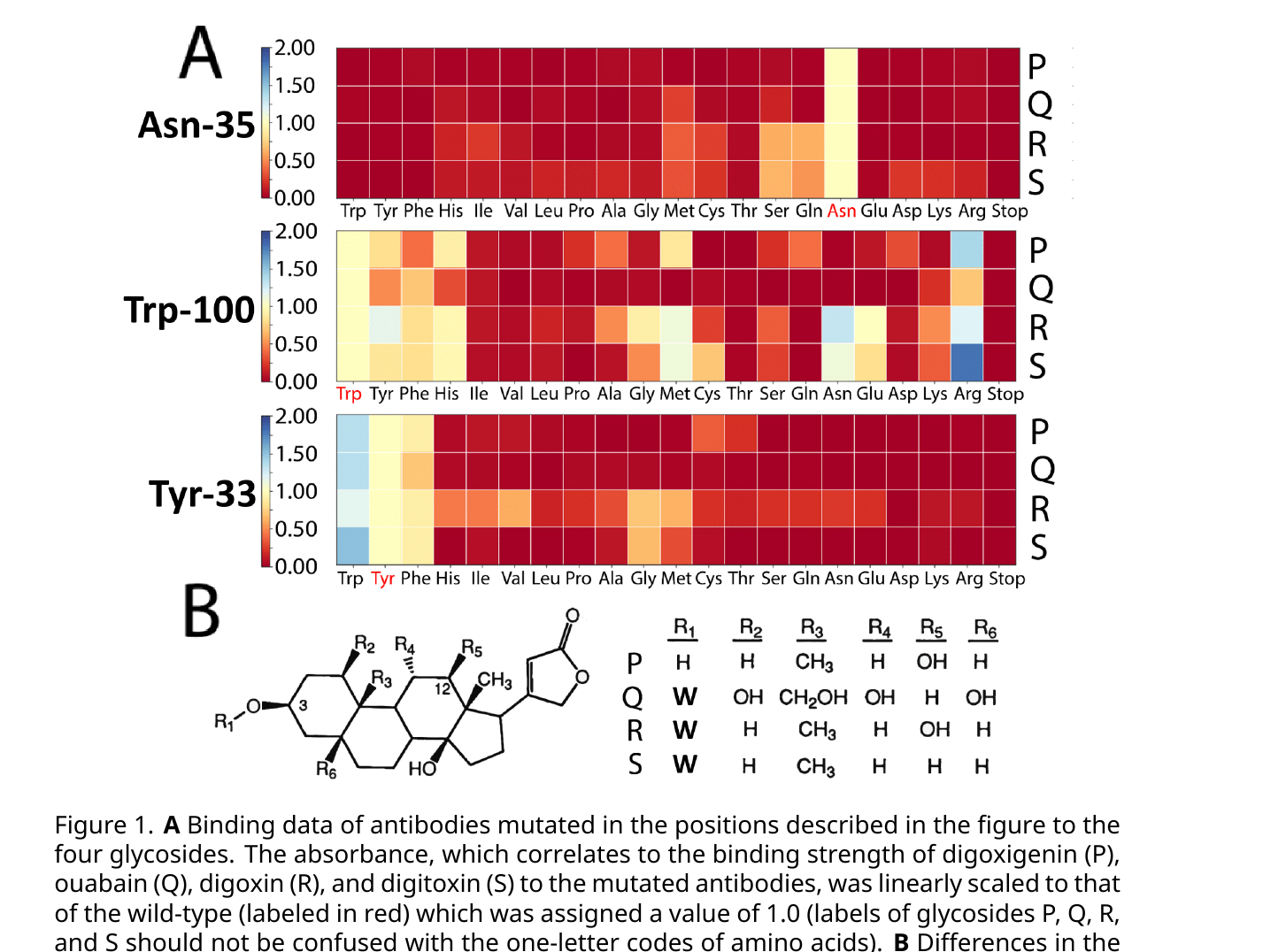 Figure 1. A Binding data of antibodies mutated in the positions described in the figure to the four glycosides. The absorbance, which correlates to the binding strength of digoxigenin (P), ouabain (Q), digoxin (R), and digitoxin (S) to the mutated antibodies, was linearly scaled to that of the wild-type (labeled in red) which was assigned a value of 1.0 (labels of glycosides P, Q, R, and S should not be confused with the one-letter codes of amino acids). B Differences in the structure of digoxin (R) and its three analogs. W - sugars.
On your answer sheet, indicate “T” for true statements and “F” for false ones.
Question reproduced from IBO 2024, Theoretical Exam Part A, licensed under CC BY-NC-SA 4.0 - attributed to the International Biology Olympiad. Open the full exam PDF · Community solutions (unofficial)