Q6 - Ramachandran Plot and Peptide Bond Geometry
The bonds between the central carbon atom and attached groups in peptides can rotate freely. The rotation angles of the N-Cα and Cα-C bonds are called φ (phi) and ψ (psi) angles, respectively. To measure the φ angle, first draw the Cα-C bond horizontally so that the N group is at 0 degrees (in the same plane as the Cα-C bond). Then rotate the distal N group around the Cα-C bond until the structure matches the structure that you aim to measure as shown in Figure 1C. For the ψ angle, place the N-Cα bond horizontally and rotate the distal C group. The Ramachandran plot visually represents the combinations of φ and ψ angles in a peptide backbone (Figure 1B).
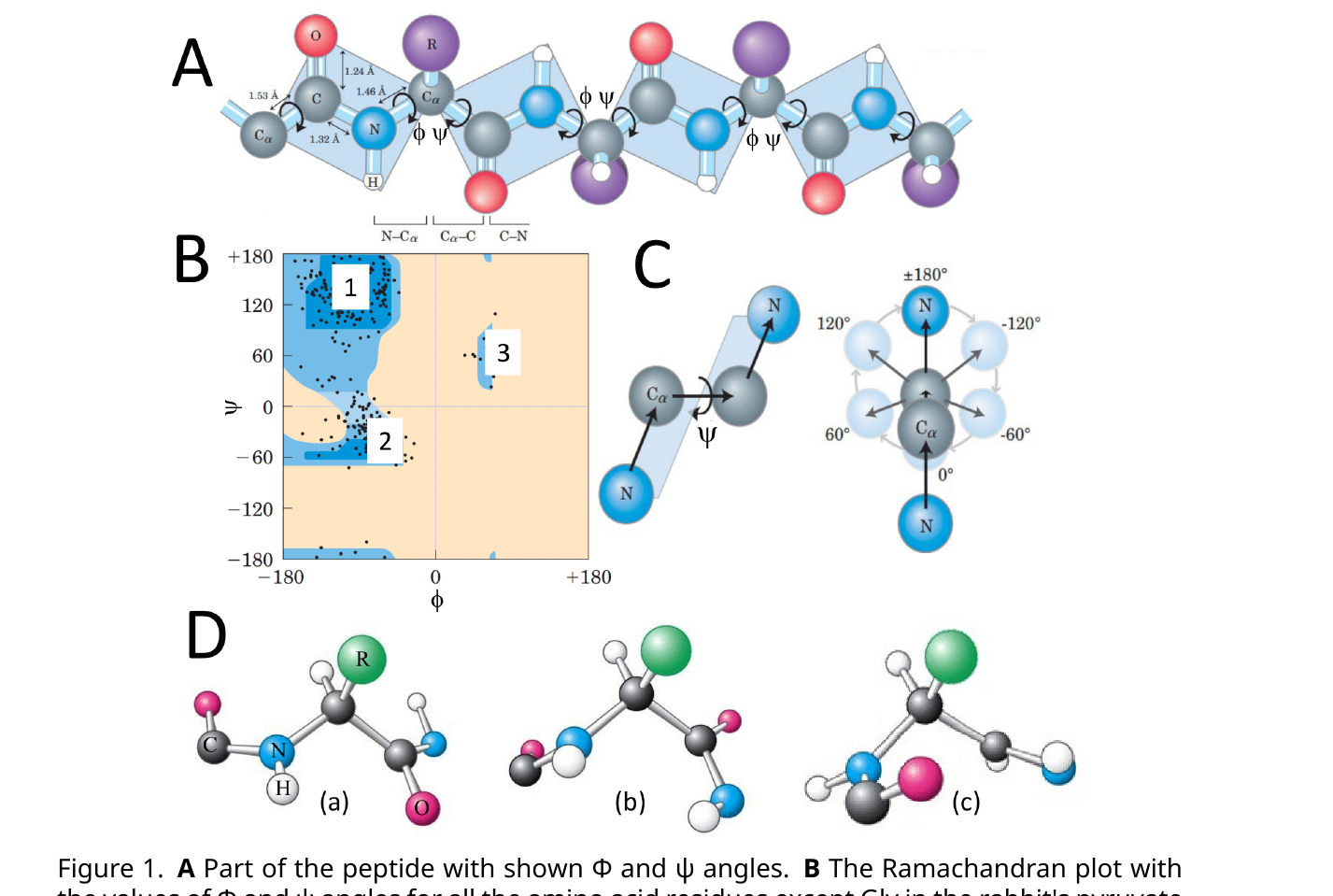 Figure 1. A Part of the peptide with shown φ and ψ angles. B The Ramachandran plot with the values of φ and ψ angles for all the amino acid residues except Gly in the rabbit’s pyruvate kinase. C The φ angle values are created by the rotation. D Three structures of amino acids’ residues.
On your answer sheet, indicate “T” for true statements and “F” for false ones.
Question reproduced from IBO 2024, Theoretical Exam Part A, licensed under CC BY-NC-SA 4.0 - attributed to the International Biology Olympiad. Open the full exam PDF · Community solutions (unofficial)